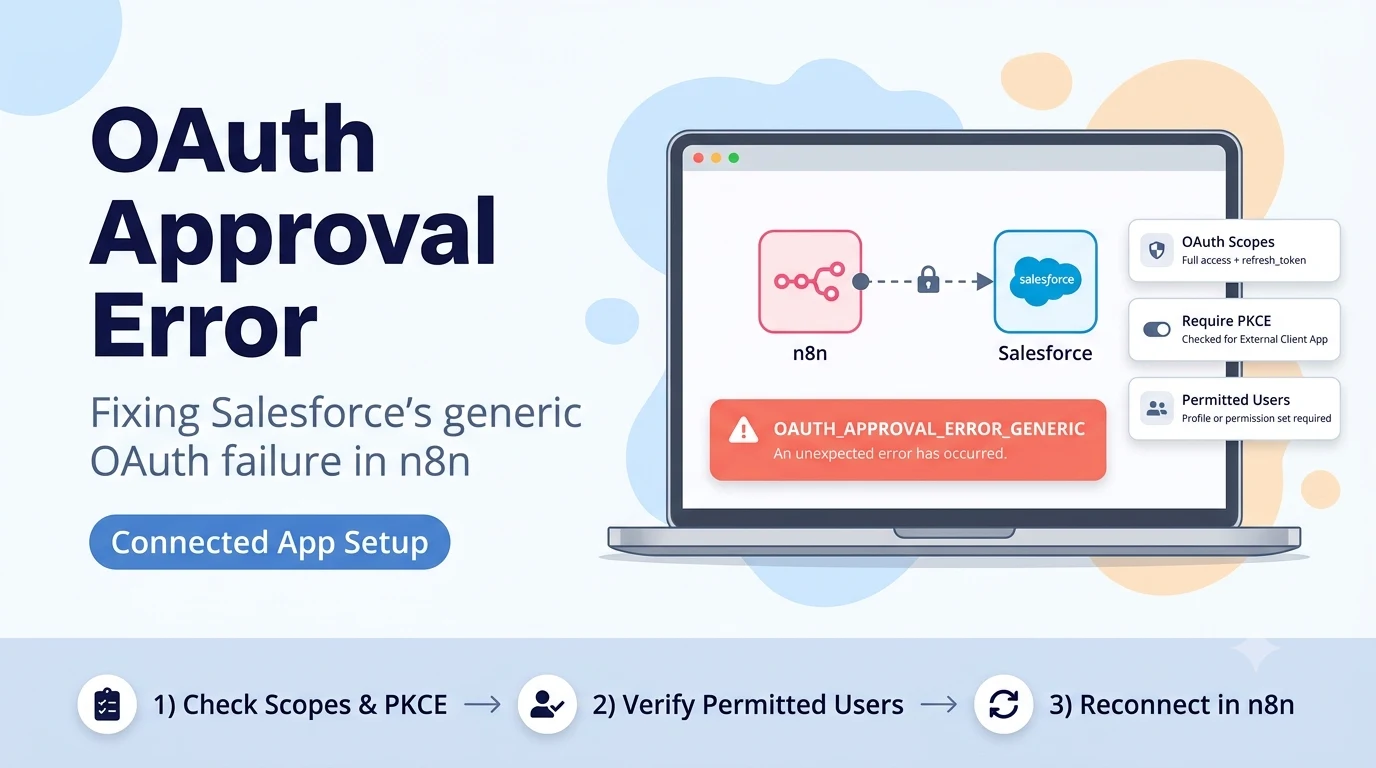
Salesforce OAUTH_APPROVAL_ERROR_GENERIC
Why the Salesforce authorization popup fails with an unexpected-error message when you try to connect an n8n credential, and the Connected App settings that actually cause it.
Open fix →16 exact-error fixes for n8n + Salesforce automations in production. No broad tutorials — only the failure modes that break a live sync.
Why the Salesforce authorization popup fails with an unexpected-error message when you try to connect an n8n credential, and the Connected App settings that actually cause it.
Open fix →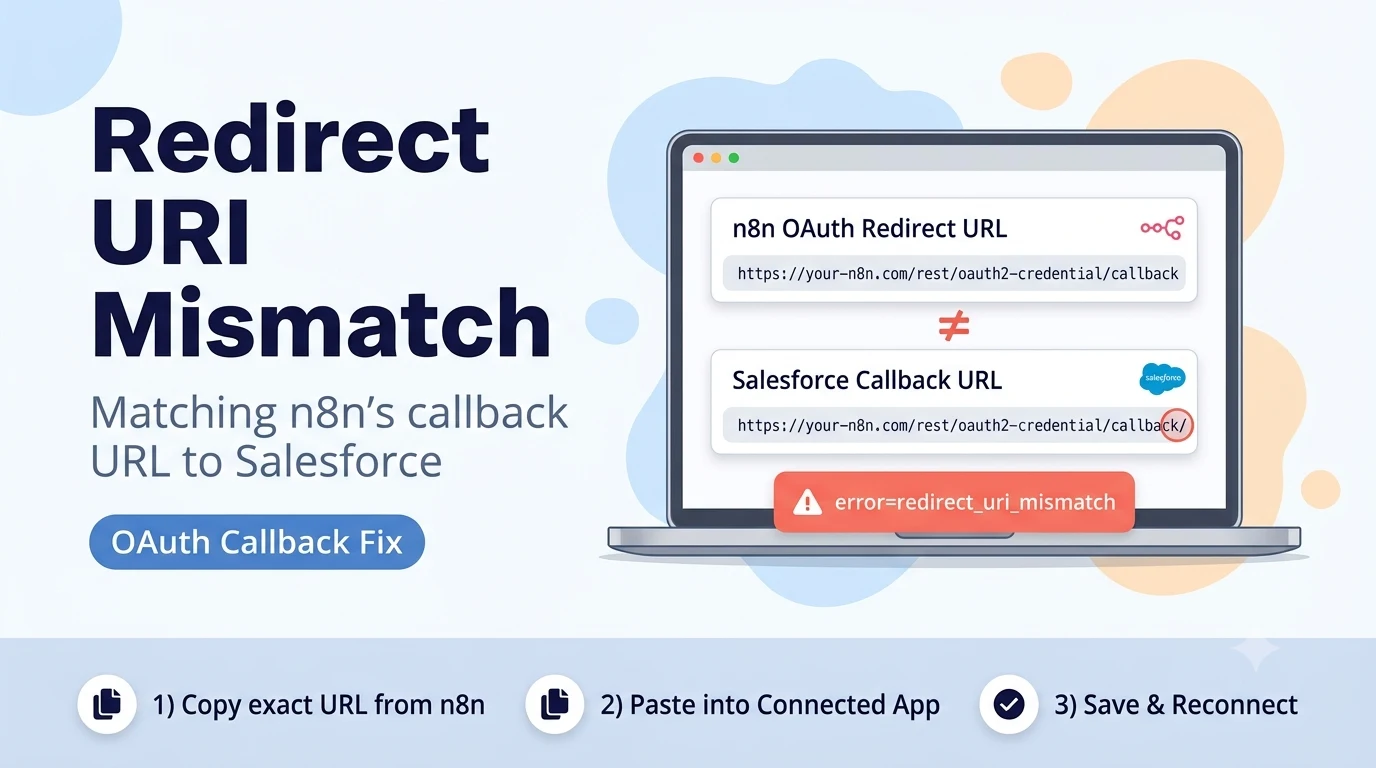
The exact place two URLs have to match character-for-character when a Salesforce Connected App rejects n8n's OAuth callback, including the http vs https and trailing-slash mistakes that cause it.
Open fix →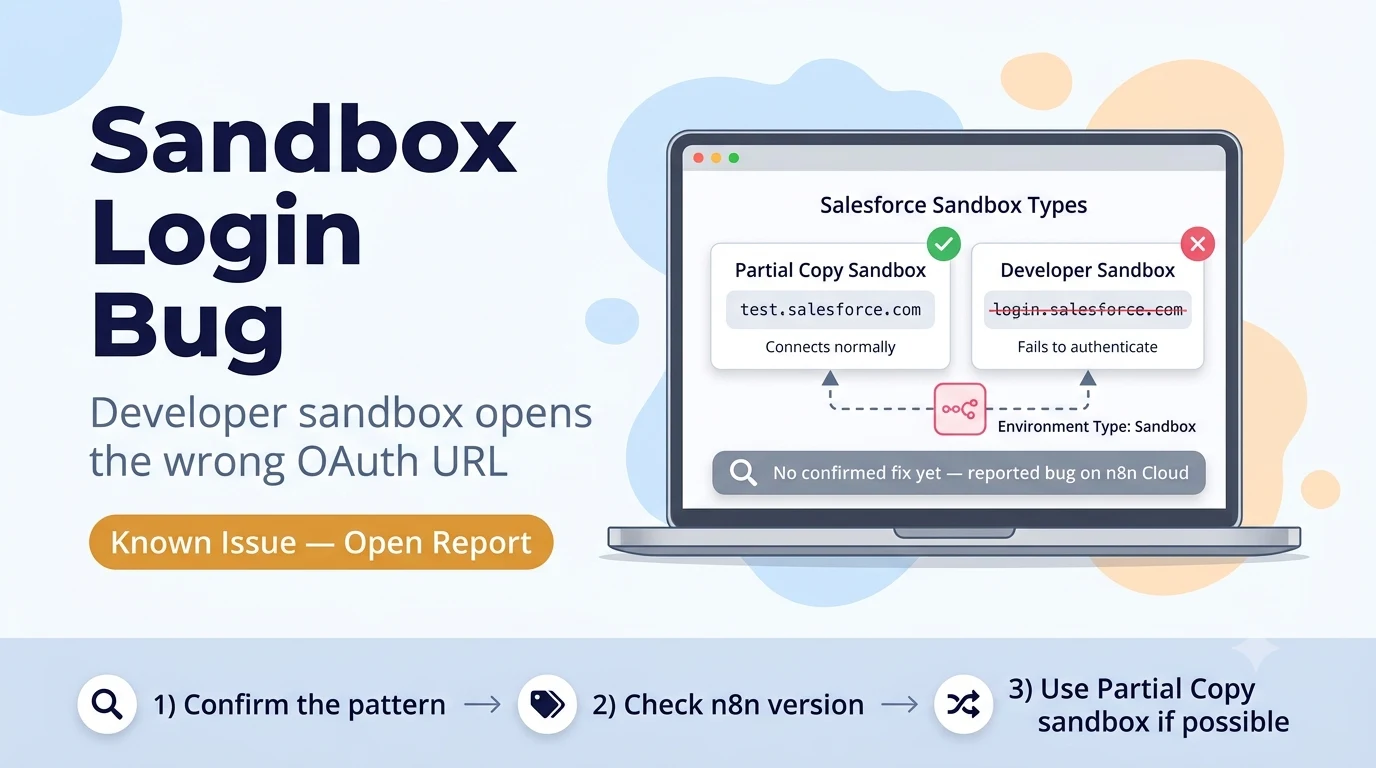
Why n8n's Salesforce credential can fail to authorize against a Developer sandbox specifically, even though the same setup works for a Partial Copy or Full sandbox.
Open fix →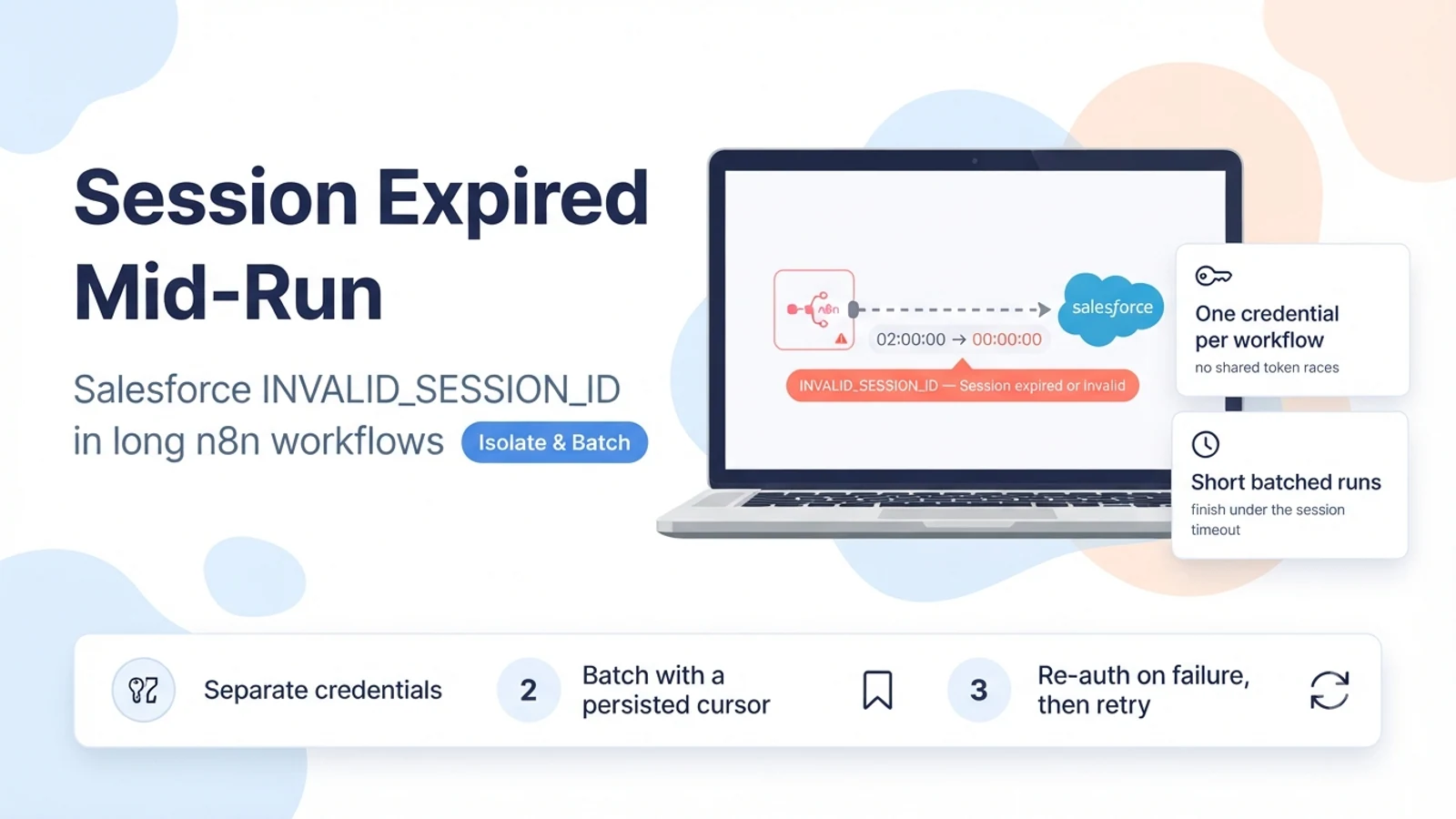
Salesforce sessions expire (default two hours) and the token endpoint returns no expiry, so n8n keeps using a session Salesforce has already invalidated. Isolate credentials per workflow, keep each run short, and let n8n re-authenticate on failure.
Open fix →
External Client App or legacy Connected App, the PKCE and Require Secret combinations that differ between them, the scopes an integration actually needs, and the propagation delay that makes a correct setup look broken.
Open fix →
The error means the app demands PKCE and the client did not send it. What the three parameters are, how to generate them correctly, and why the mismatch usually comes from mixing up two app types.
Open fix →
A refresh replaces the org. Refresh tokens, the app's Consumer Key, the integration user and often the My Domain host are all new — so the credential fails for four independent reasons at once.
Open fix →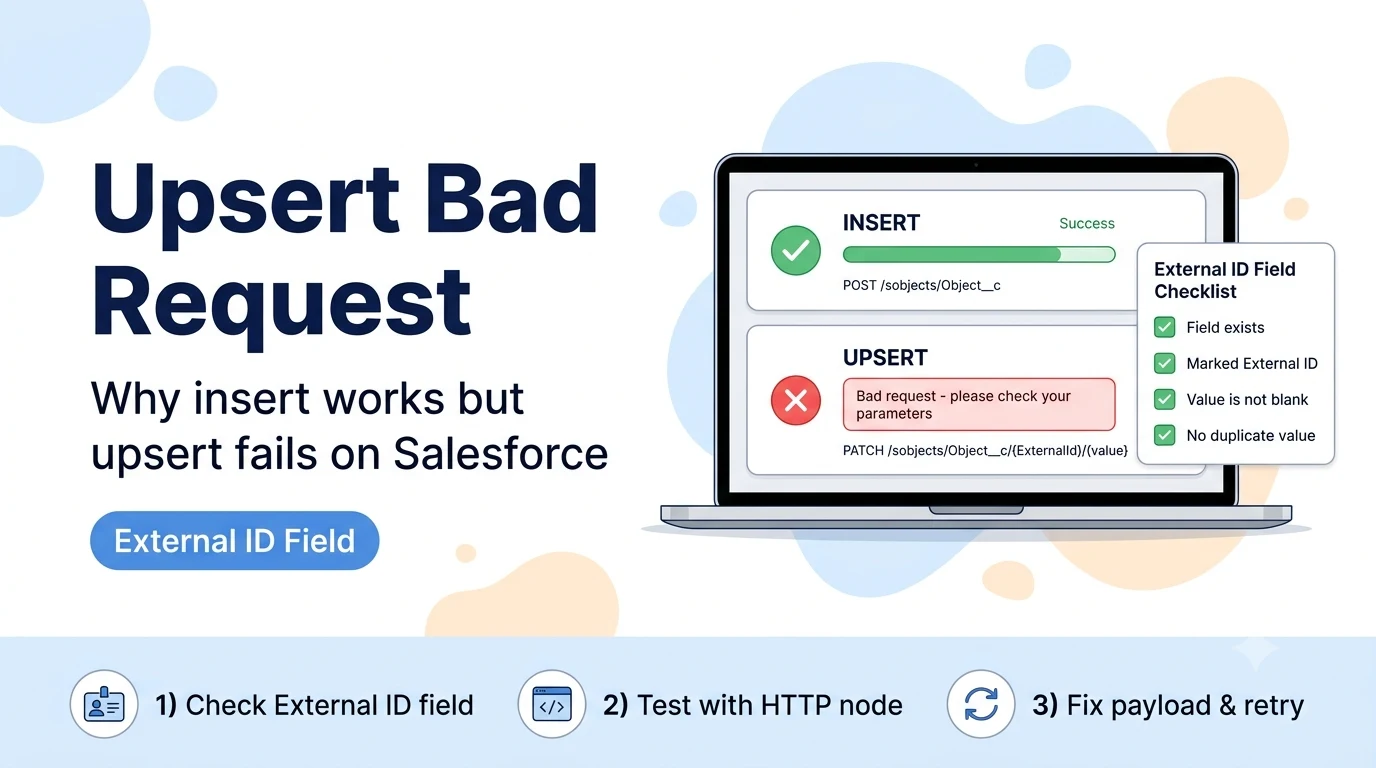
Why the Salesforce node's upsert operation can fail with a vague bad-request message on a custom object even when insert works, and the field-level checks that usually explain it.
Open fix →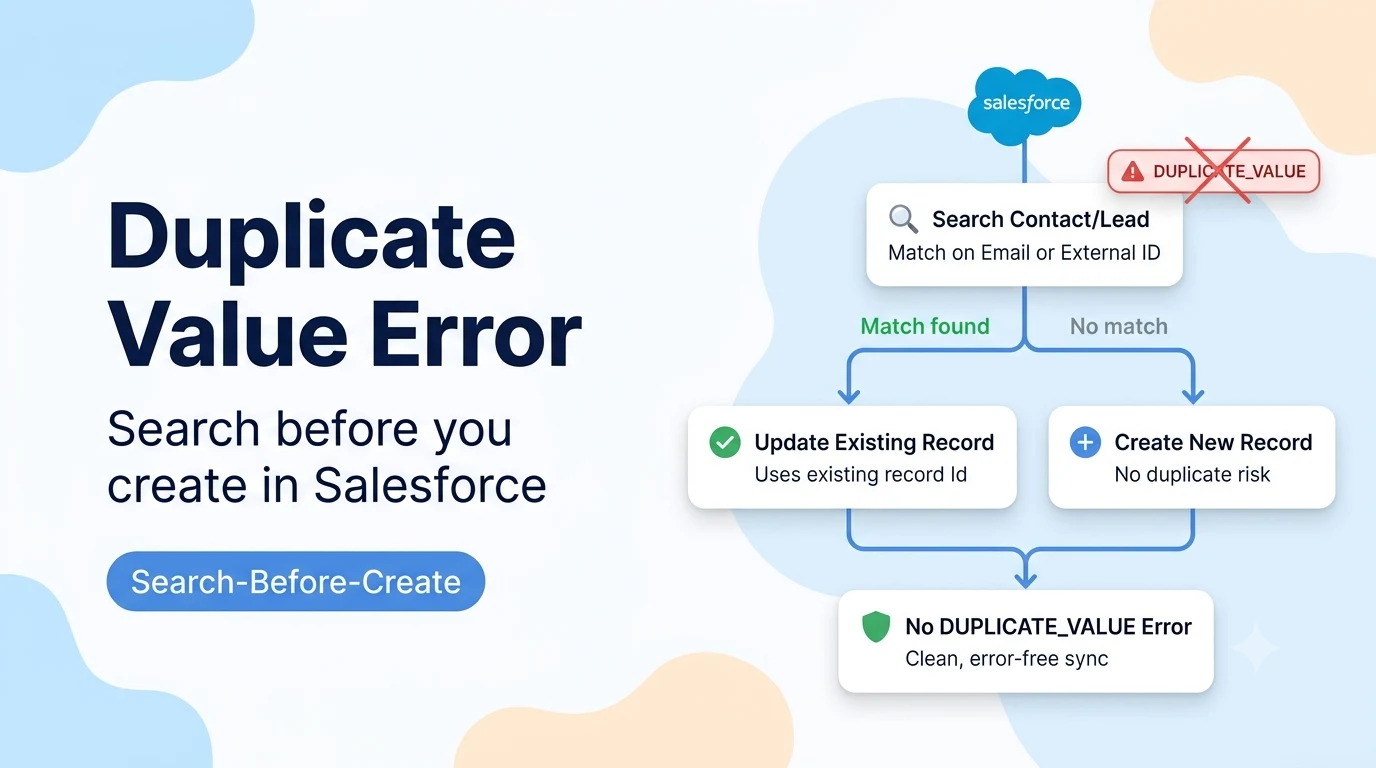
Why a Salesforce Create operation from n8n fails with DUPLICATE_VALUE or DUPLICATES_DETECTED, and the search-before-create pattern that fixes it for good.
Open fix →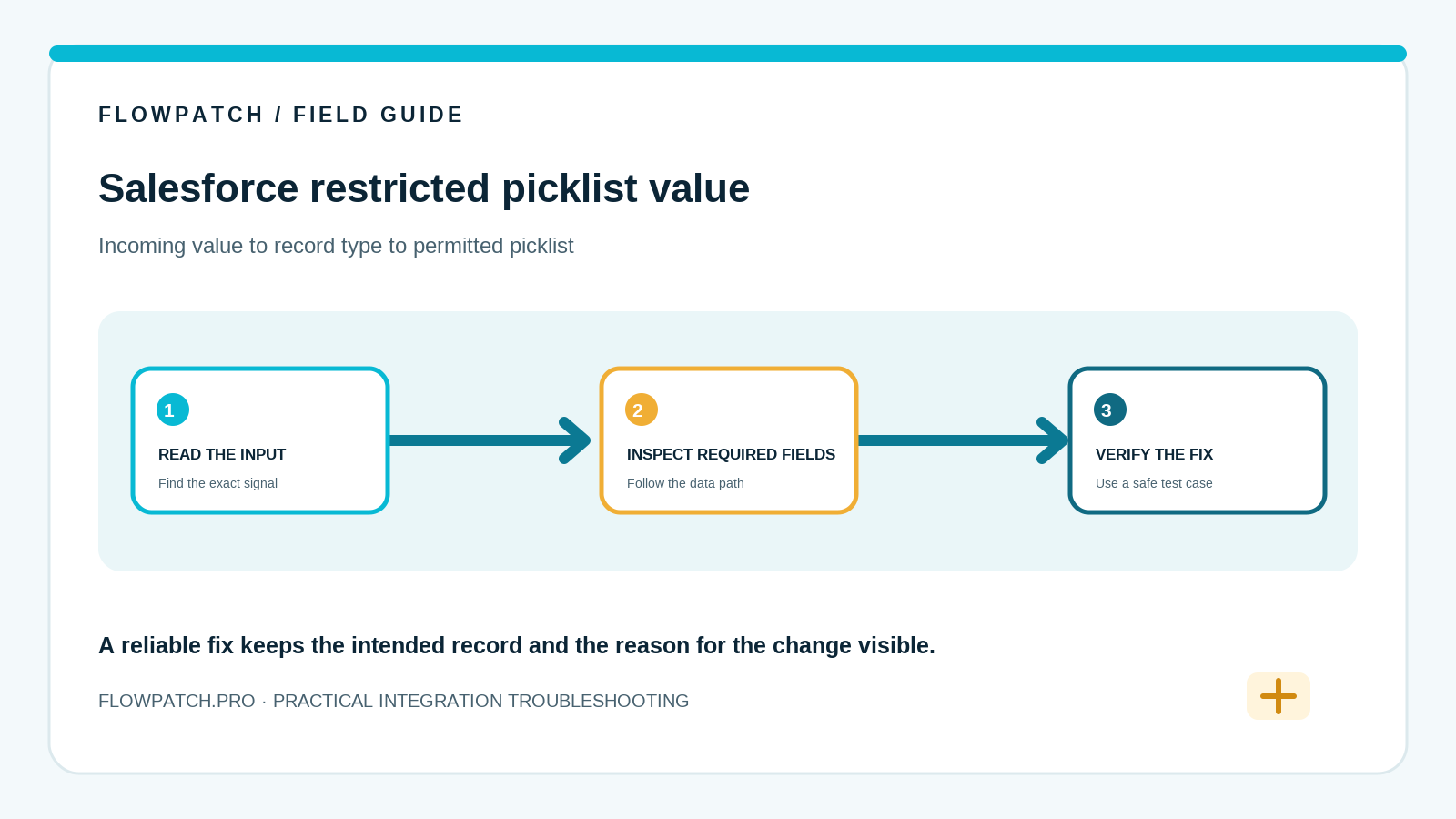
Salesforce restricted picklists reject any value not in their defined set. n8n usually sends the label, the wrong case, a trailing space, or a value not enabled for the record type. Send the exact API value, case-sensitive, mapped to the record type.
Open fix →Four causes produce this one error: the label instead of the value, a case or whitespace difference, an inactive value, or a value the target record type does not expose. How to tell which, in one describe.
Open fix →
The error names the field, and the field is often not required in the object's metadata at all. The five places a requirement can come from, and how to find which one is enforcing it.
Open fix →
A field's describe lists forty values while the record type you are writing to allows eight. Which endpoint answers the question that governs the write, and how to make mapping record-type-aware.
Open fix →
One rejects unknown values loudly; the other accepts them silently and pollutes the value set. The describe flag that tells them apart, and why the loud one is what an integration should want.
Open fix →
One REST resource returns every allocation with its max and remaining. Which line actually governs your workload, what it costs to read, and how to alert before a backfill takes the org's integrations down.
Open fix →
REST tells you immediately and per request; Bulk 2.0 tells you afterwards, per row, in a results file you have to fetch. The two failure models, and the retry logic each one needs.
Open fix →