Guides / Integrations / Pipedrive
Integration desk

n8n × Pipedrive Error Desk

16 exact-error fixes for n8n + Pipedrive automations in production. No broad tutorials — only the failure modes that break a live sync.

Authentication

Illustrated troubleshooting diagram for Pipedrive API token vs OAuth: which one to use for a private integration.
Authentication•6 min

Pipedrive API token vs OAuth

An API token is one user's identity with that user's visibility. OAuth is an installable app with scopes and refresh. The concrete request differences, and the permission trap that makes a token look like it is losing data.

Open fix →
Data Sync

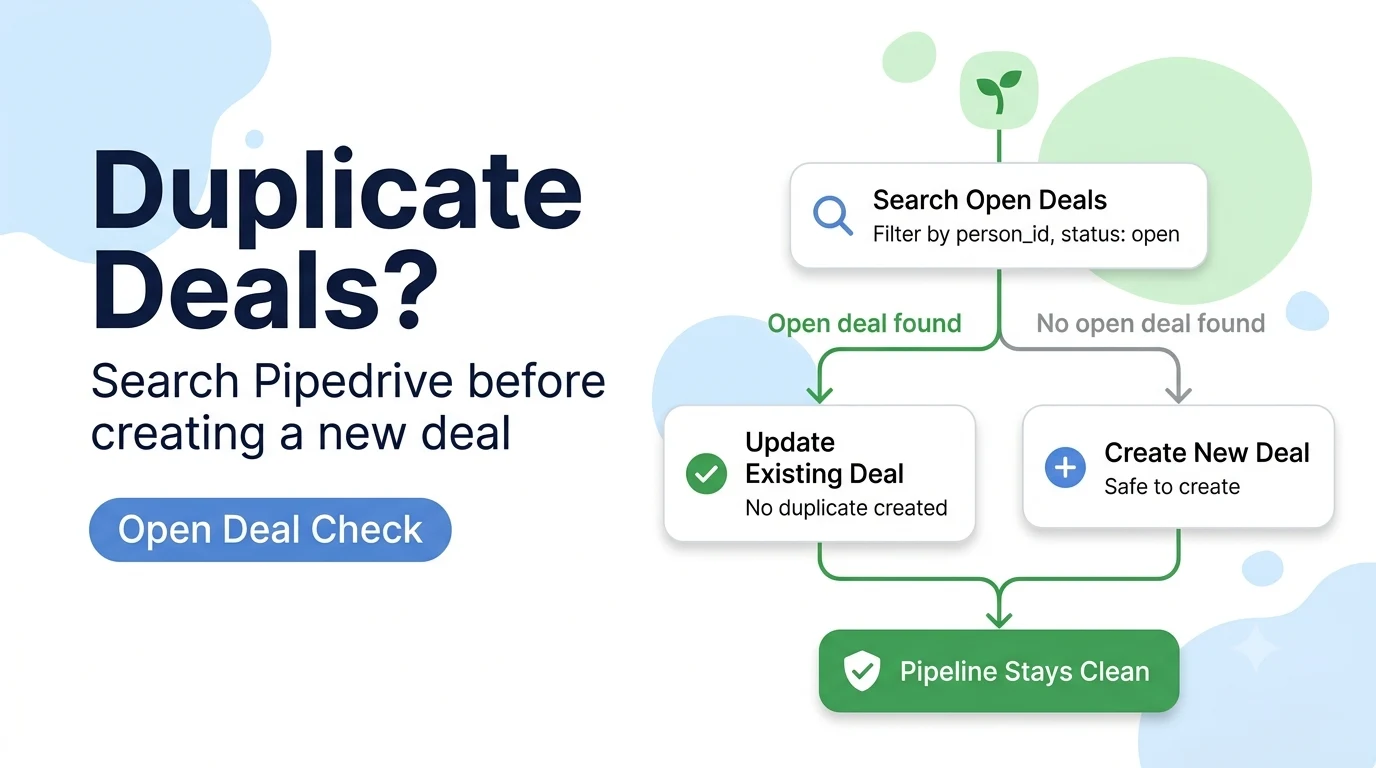
Illustrated flow showing an n8n workflow searching Pipedrive for an existing deal before creating a new one to prevent duplicates.
Data Sync•10 min

Pipedrive duplicate deal prevention

Pipedrive has no built-in duplicate-deal blocking like Salesforce's Duplicate Rules — here's the search-then-branch pattern that actually stops repeat automations from creating the same deal twice.

Open fix →

Data Validation

Illustrated troubleshooting diagram for Preventing duplicate people and organizations when creating records via the Pipedrive API.
Data Validation•6 min

Pipedrive duplicate prevention

Pipedrive's create endpoints do not deduplicate. Search-then-create narrows the window but does not close it; an idempotency key stored on the record does. Both patterns, with the calls.

Open fix →

Field Mapping

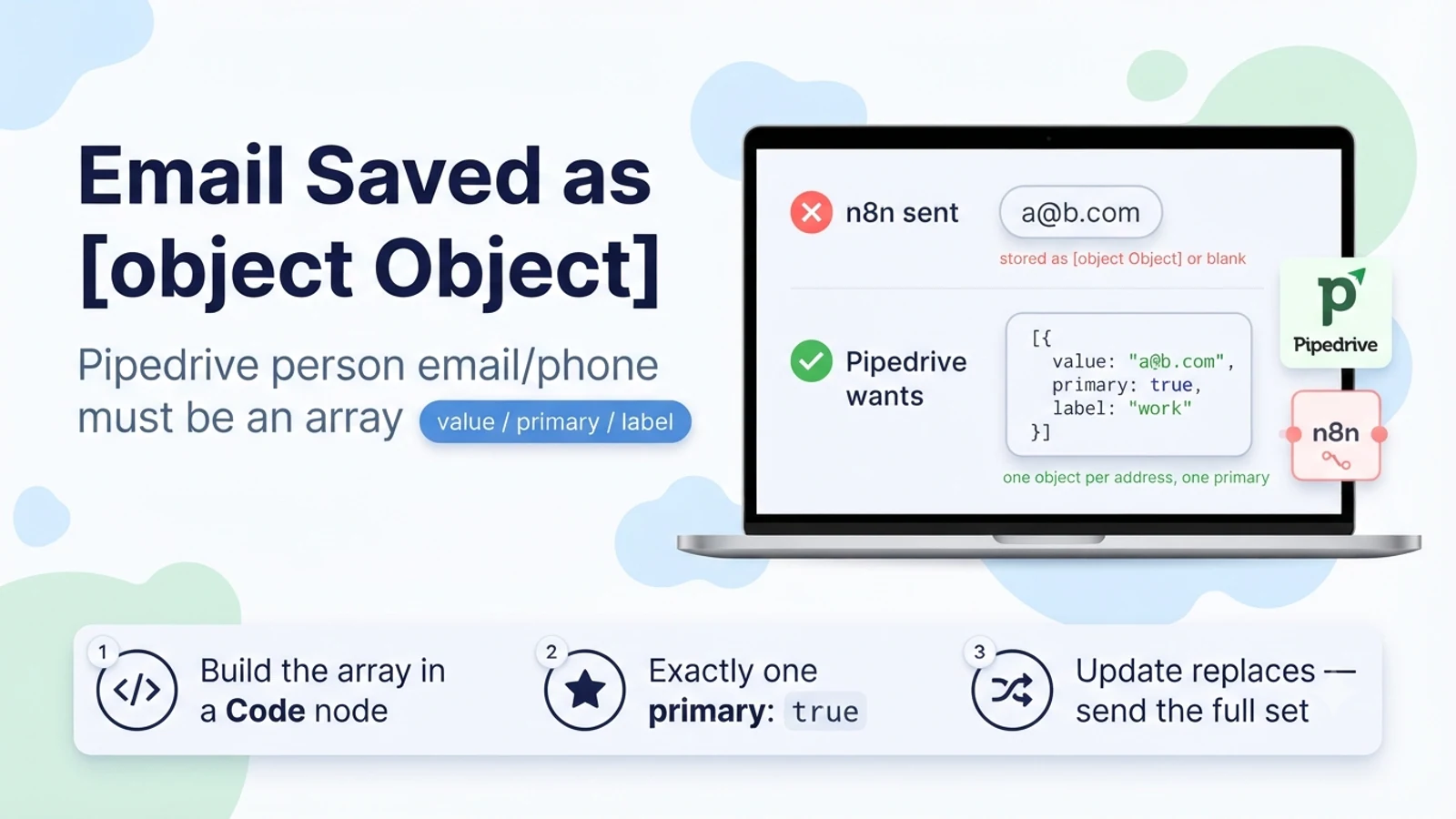
Comparison graphic showing a plain email string stored as [object Object] versus the array-of-objects shape (value, primary, label) Pipedrive expects from n8n.
Field Mapping•10 min

Pipedrive person email/phone format in n8n

Pipedrive's Persons API expects email and phone as an array of objects with value, primary, and label. Sending a plain string, or letting n8n stringify an object, saves [object Object] or drops the value. Build the array explicitly.

Open fix →

Field mapping

Illustrated troubleshooting diagram for Pipedrive API v2: field_code vs field ID — the querystring change that breaks old integrations.
Field mapping•6 min

Pipedrive v2 custom_fields shape

v1 put custom field hashes at the top level of the record; v2 nests them under custom_fields and stops returning them unless asked. The four changes that break a v1-shaped integration, with both payloads side by side.

Open fix →
Illustrated troubleshooting diagram for Pipedrive custom dropdown and multi-select fields: why the option ID does not match the UI.
Field mapping•6 min

Pipedrive dropdown option IDs

A correct field key is only half of an option field. Each dropdown choice has its own numeric ID, and the visible text is never accepted. Where to find the IDs, and how multi-select differs from single-select.

Open fix →
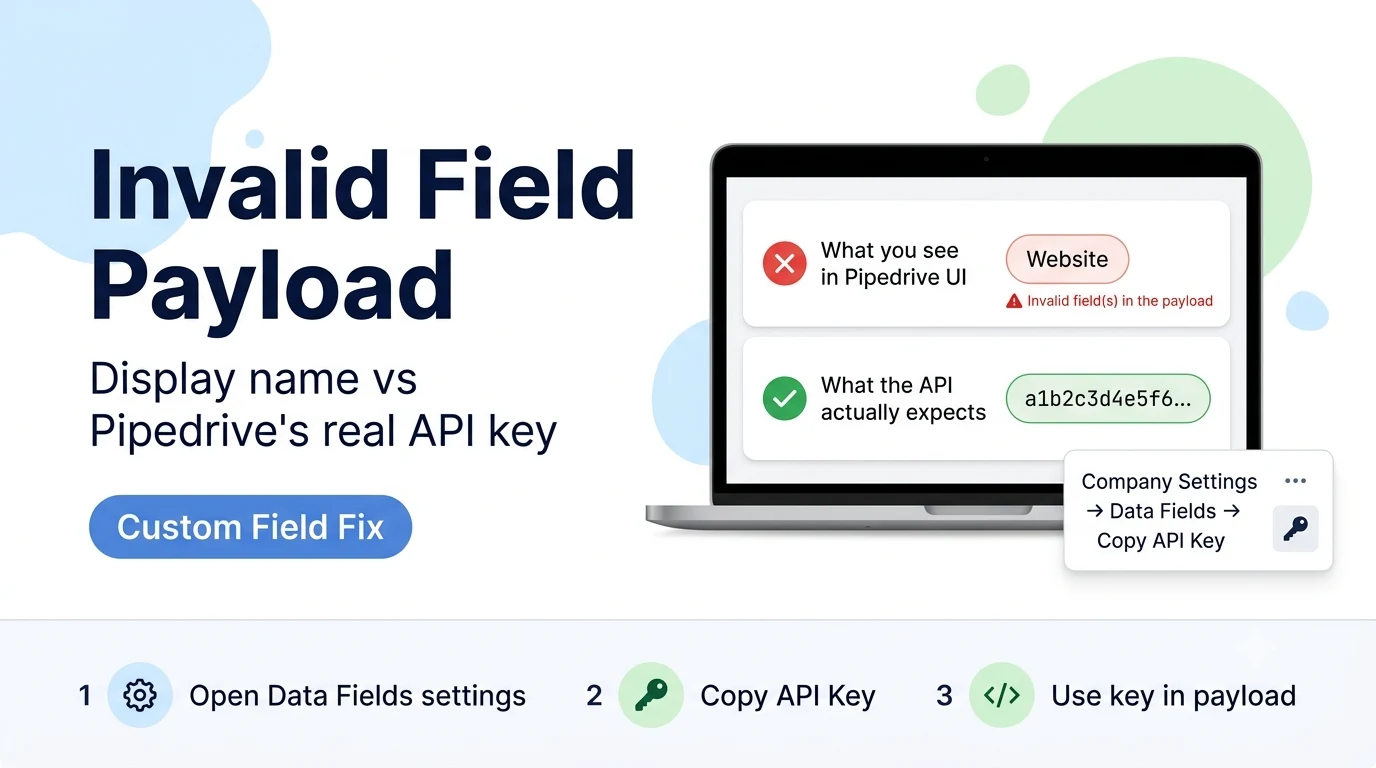
Illustrated troubleshooting diagram for How to find a Pipedrive custom field's real API key.
Field mapping•5 min

Find a Pipedrive custom field key

Pipedrive generates a 40-character hash when a custom field is created and that hash is the only key the API accepts. Both ways to find it, and why the UI label is never a substitute.

Open fix →

Platform Change

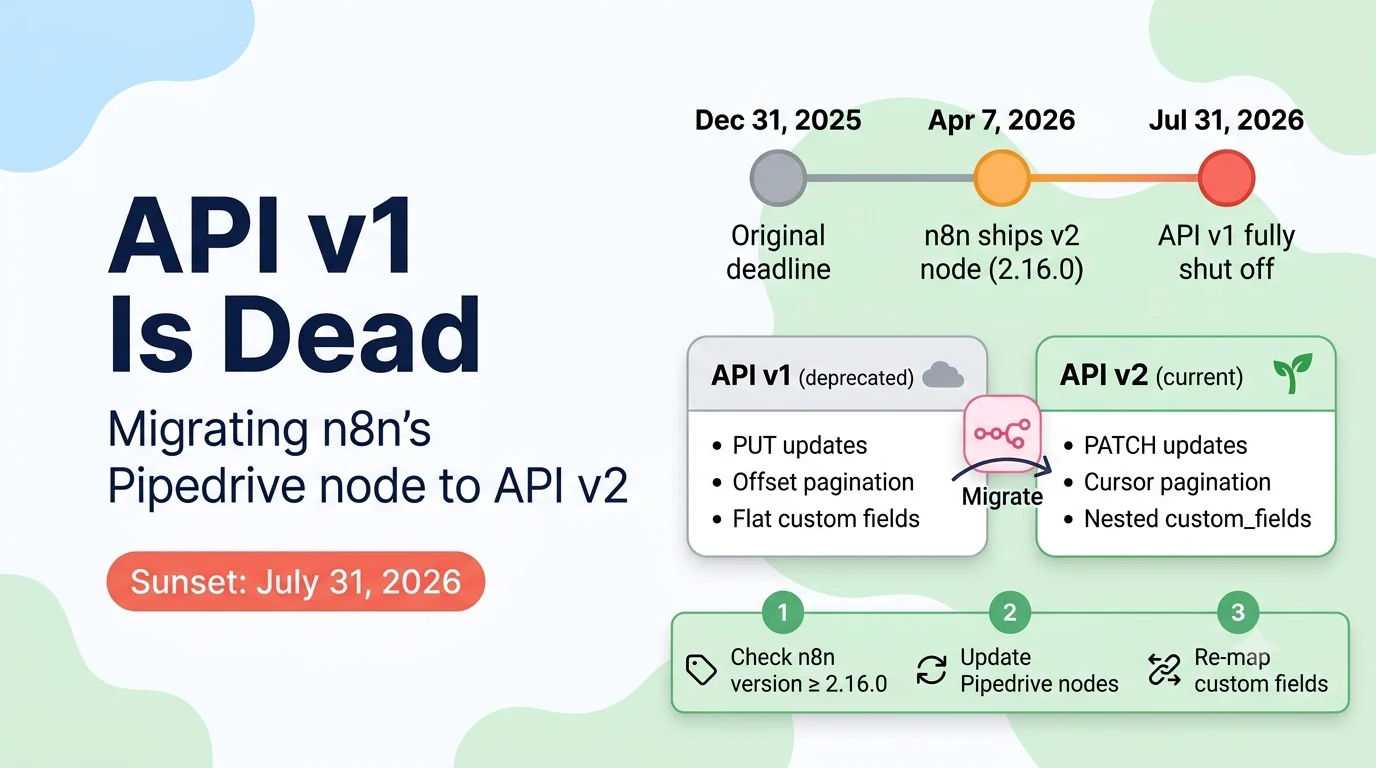
Illustrated diagram showing n8n workflows migrating from the deprecated Pipedrive API v1 to the current API v2 node.
Platform Change•13 min

Pipedrive API v1 deprecation in n8n

Pipedrive shut down API v1 endpoints on July 31, 2026. Here's exactly which n8n Pipedrive node resources were affected, which n8n version fixes it, and what changes in your workflows.

Open fix →

Rate limits

Illustrated troubleshooting diagram for Pipedrive API 429 errors: how the token-based daily budget actually works.
Rate limits•6 min

Pipedrive token-based rate limit

Pipedrive does not count requests, it charges tokens, and different endpoints cost different amounts. The budget formula, why a search-heavy workflow exhausts it far faster than a write-heavy one, and what to do when it runs out.

Open fix →
Illustrated troubleshooting diagram for How to reduce Pipedrive API token consumption per request.
Rate limits•6 min

Reduce Pipedrive token consumption

Pipedrive charges by cost, not by call, so the wins come from removing expensive work: search replaced by keyed reads, metadata cached, cursors persisted, and reconciliation separated from event handling.

Open fix →

Triggers & Webhooks

Triggers & webhooks

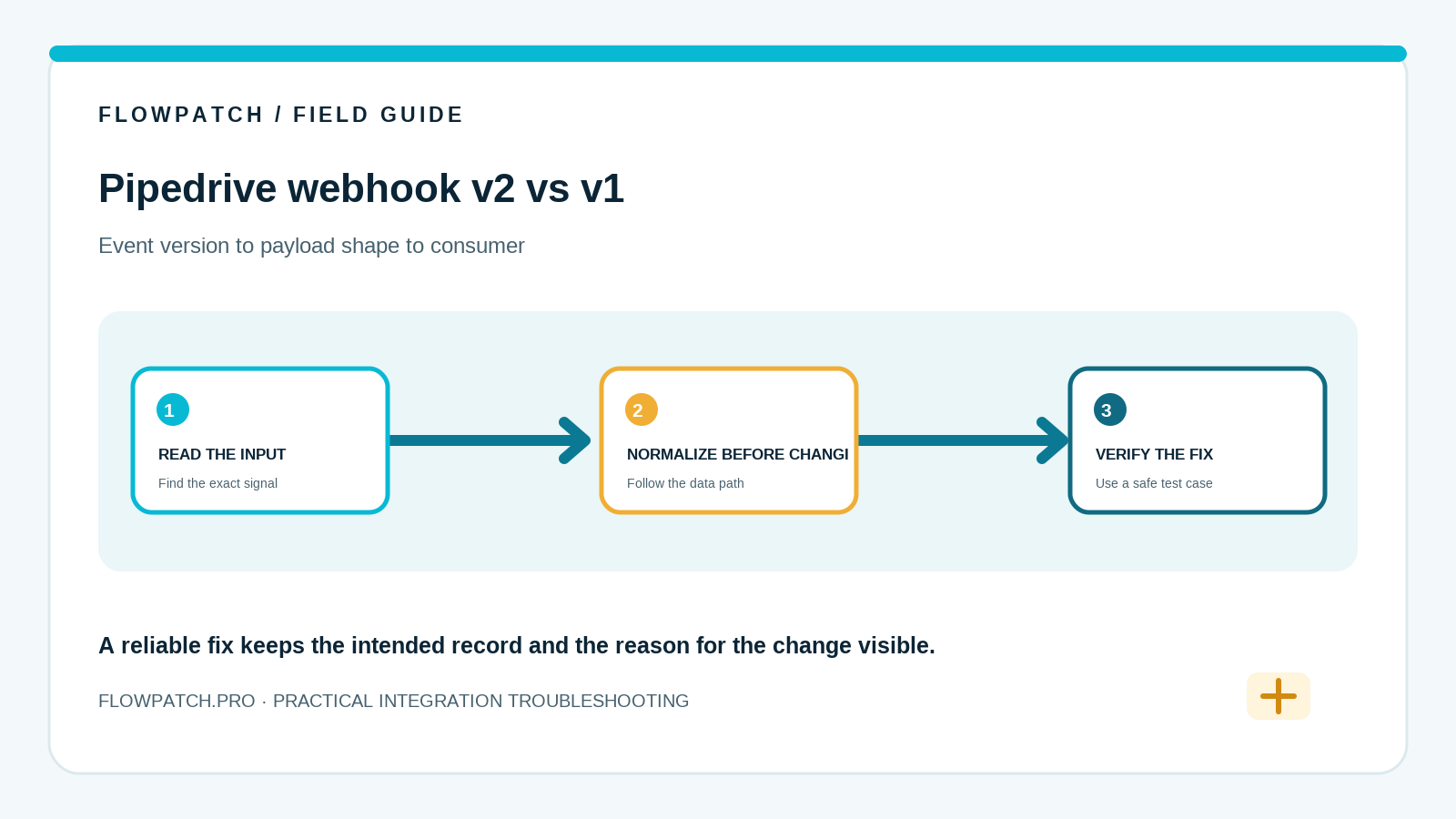
FlowPatch diagram: Event version to payload shape to consumer. Normalize before changing downstream logic.
Triggers & webhooks•6 min

Pipedrive webhook v2 payload

Version 2 renames the fields a receiver reads on every event: current becomes data, meta.object becomes meta.entity, and the identifiers move. What breaks, and how to accept both during the transition.

Open fix →